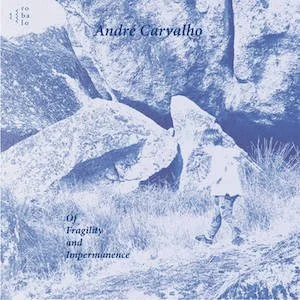
André Carvalho - Of Fragility and Impermanence

Label: Robalo, 2025

Personnel - Andre Carvalho: double bass; José Soares: alto saxophone, bass clarinet; Raquel Reis: cello; Samuel Gapp: piano; João Hasselberg: electronics.

Inspired by parenthood, a series of life changes that led to self-discovery, as well as memories of his own childhood, Portuguese bassist and composer André Carvalho releases Of Fragility and Impermanence, a collection of 12 tracks that firmly situates itself on the left side of the jazz spectrum. Throughout his career, Carvalho—who lived in New York for seven years—has consistently demonstrated his strengths as a composer, leader, and sideman. More recently, he has devoted time to film scoring, earning several awards in the process.

The fascinating “A Galope” opens the album, foregrounding electronics and shaping its ebb and flow through counterpoint and carefully paced motion. Rooted in contemporary classical music, jazz experimentalism, and the fertile space between them, the piece builds toward a vibrant rhythmic current before receding quietly. Carvalho’s trenchant arco work and Samuel Gapp’s expansive piano gestures are especially striking here. “Dentes de Leite” follows as a vaporous ballad whose poised elegance is matched by its sophisticated 3+3+2 pulse.

The quintet’s unconventional instrumentation serves the poignant “Dores de Crescimento”, an ambient piece grounded in cello legato, bass, and electronics, and crowned by serene piano lines and José Soares’ drifting, ethereal saxophone. Channeling modern classical figures such as Ives, Mompou, and Debussy, the piece also reflects a modal sensibility reminiscent of English saxophonist John Surman. “Echoes” leads us into a strange yet quietly magical realm, balancing serenity, ambiguity, and emotion, and evoking a cinematic surrealism through contrasting timbres and softly undulating waves of warmth.

Infância” stands confidently on its own as a feature for bass and saxophone, their reciprocal dialogue lightly veiled by a thin haze of electronics. It recalls the classically inflected work of Tuxedomoon’s Steven Brown. “The Journey of Kanji Watanabe”—named after the protagonist of Akira Kurosawa’s Ikiru (1952)—unfolds with pure elegance, offering a minimalist, contemplative meditation on bodily fragility, illness, and death. A related sense of vulnerability permeates the floating chamber atmosphere of “Trica de Irmãos”, though expressed differently: here, a gentle tenderness emerges through measured restraint, carried by Soares’ lyrical bass clarinet and Carvalho’s sensitive bass solo. By contrast, “No Man Ever Steps in the Same River Twice…” adopts a more energetic stance, driven by contrapuntal and parallel lines and taut, staccato-laced passages.

Flawlessly arranged, Of Fragility and Impermanence is emotive and layered without becoming ponderous. The ensemble plays as a true collective, bringing Carvalho’s vision to life with honesty, musical depth, and imagination. It is an album to be discovered slowly, preferably in the quiet of the night.

Favorite Tracks:
01 - A Galope ► 03 - Dente de Leite ► 04 - Dores de Crescimento ► 08 - No man ever steps in the same river twice…

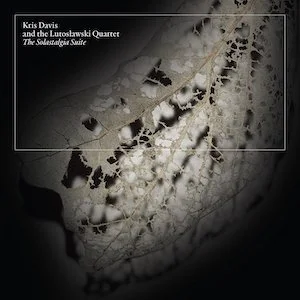
Kris Davis and the Lutoslawski Quartet - The Solastalgia Suite

Label: Pyroclastic Records, 2026

Personnel - Kris Davis: piano, composition + Lutoslawski Quartet - Roksana Kwasnikowska: violin; Marcin Markowicz: second violin; Artur Rozmyslowicz: viola; Maciej Mlodawski; cello.

Commissioned by the Jazztopad Festival in Wroclaw, Poland, The Solastalgia Suite marks the first opus for piano and string quartet by the exploratory Canadian pianist and composer Kris Davis. The Lutoslawski Quartet helps give voice to compositions influenced by Olivier Messiaen and thematically centered on philosopher Glenn Albrecht’s term solastalgia, a word that defines a form of homesickness experienced while one is still at home.

The opener, “Interlude”, ushers the listener into the record’s distinctive world through a sequence of energetic, staccato-driven gestures, counterpoint, and improvisation. If this piece coheres and enchants, “An Invitation to Disappear” deepens the sense of contemplation and emotional pull, combining restless shards of strings with beautifully shaped, piano-centered passages.

In “The Known End”, modern classical and contemporary chamber elements generate suspenseful, cinematic cadences, punctuated by abrupt starts and stops and kinetic piano reflections. The string quartet’s broad range of attack yields sections that explore contrasting variations, combinations, and atmospheres, with Davis using dynamics expressively throughout. “Pressure & Yield” feels harmonically open, placing acerbic bowed cello and violin at the heart of an intriguing, tense dialogue.

Featuring prepared piano, “Towards No Earthly Pole” draws everything down to a hush, though its repetitiveness slightly dulls the impact. By contrast, “Degrees of Separation”, with its firm sense of direction, is whimsically structured, blurring the boundaries between composition and improvisation through finely interlocking moments and responsive interplay. It proves more compelling than most of the preceding pieces, introducing a broader spirit of adventure, even in passages dominated by dreamy piano textures set against floating strings.

One might wish the earlier movements shared the same strength and dynamism as this closing statement. Still, despite a degree of unevenness, those inclined to find beauty in abstraction and creative risk will discover a rewarding experience in The Solastalgia Suite.

Favorite Tracks:
01 - Interlude ► 02 - An Invitation To Disappear ► 08 - Degrees of Separation