
Label: Clap Your Hands, 2025
Personnel - Tineke Postma: alto and soprano saxophone; Theo Bleckmann: vocals (#1,4,5,8); David Doruzka: guitar; Robert Landfermann: double bass; Tristan Renfrow: drums.
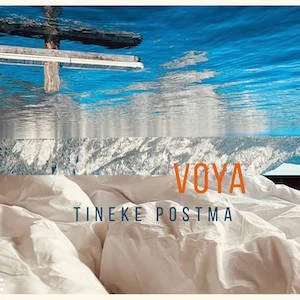
Voya, the ninth album by Dutch saxophonist and composer Tineke Postma, finds her at the helm of a tightly knit European quartet of long-standing collaborators: guitarist David Dorůžka, bassist Robert Landfermann, and drummer Tristan Renfrow. The added distinction here is the presence of German-born, New York–based avant-garde vocalist Theo Bleckmann on selected tracks. Bleckmann has become a singular voice on the contemporary scene through close collaborations with John Hollenbeck, Ben Monder, and Meredith Monk. In a comparable way, Postma has built her own path through sustained musical relationships. As a leader, she has worked with figures such as Geri Allen, Ralph Alessi, Greg Osby, and Kris Davis; as a sidewoman, she has appeared alongside Terri Lyne Carrington, Dianne Reeves, and Amina Figarova.
The album’s title carries a threefold meaning: voyage, voice, and Oya, the Yoruba goddess of winds and storms. It opens with “Unity and Four Reasons of Hope”, where saxophone and voice intertwine with ease, floating over impulsive bass movement and sensitively brushed drums and cymbals. The piece also serves as a launchpad for focused, well-intoned individual explorations by Bleckmann and Postma, before closing with a coda that allows Renfrow to step forward with finely shaped drum commentary.
“Lillies” is an adventurous, sharply etched composition built on fragmented phrasing delivered with hard-edged staccato clarity. Here, the group ventures further outside the lines, with Dorůžka proving a vital presence: his incisive interjections sharpen Postma’s commanding solo, which he then follows with a vivid statement of his own. The brief but energetic “Rhetor’s Dream” sustains a lush atmosphere, hovering somewhere between the lyrical fusion associated with Charlie Mariano and the exploratory language of the AACM tradition, while “TP4” skillfully blends slippery funk and hip-hop inflections.
Several more contemplative pieces give Bleckmann’s often overdubbed voice a central role. “Suchness” and “Mirror Oh Mirror” stand out in this regard, the former unfolding as a deeply felt chorale anchored by Landfermann’s poignant bowed bass; the latter carried out by Dorůžka’s gently arpeggiated textures. “For Theo”, Postma’s dedication to the vocalist, opens a mellow, spacious environment in which texture and color are allowed to bloom. Postma demonstrates complete command of her instrument, while Bleckmann responds with remarkable flexibility and sensitivity, reinforcing the music’s ethereal dimension.
After “IDC”, whose enigmatic mood is heightened by a disorienting tempo and an odd, grounding bass figure, the album closes with a rendition of Wayne Shorter’s “Somewhere Called Where”. This work reaffirms Postma’s commitment to personal expression, collective trust, and forward-looking sound worlds.

Favorite Tracks:
02 - Lillies ► 03 - Rhetor’s Creek ► 05 - Mirror Oh Mirror ► 10 - IDC