
Label: Intakt Records, 2026
Personnel - Anna Webber: tenor and soprano saxophones, flute; Ingrid Laubrock: tenor and soprano saxophones; Ryan Easter; trumpet; Yuma Uesaka: clarinet, contrabass clarinet, soprano saxophone; Mary Halvorson: guitar; David Virelles: piano; DoYeon Kim: 25-string gayageum; Chris Tordini: bass; Ches Smith: drums, chimes.
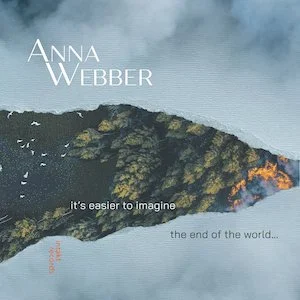
Anna Webber, a magnificent composer, saxophonist, flautist, and bandleader, makes her most political statement to date with her new album, It’s Easier to Imagine the End of the World…, for which she assembled a responsive nonet composed of some of the finest and most daring New York improvisers. Juggling progressive ideas with logic and purpose, Webber found inspiration in her beliefs as well as in a number of books about late capitalism and its effects. The track titles reproduce quotes from those books, and the album’s sequence was organized from the darkness of the present moment to the light and hope that will surface from a future direction.
The band navigates her compositional courses with remarkable unity, injecting fragments and sensibilities that sometimes clash and sometimes are happily wed. The title track, named after Fredric Jameson, opens with solo saxophone until a multiphonic smear signals the ensuing accumulation of layers, often droning and jarring, as it leads to a massively conjoint ostinato that can be interpreted as deadly serious or cartoonishly playful. Emergent gayageum player DoYeon Kim disperses notes over an insistent buzzing murmur before a more palpable harmonic tapestry runs under her feet. The horn players are heard over a nonuple-metered flow before reaching a point where Ingrid Laubrock’s freewheeling tenor solo stands out from the rest of the band flickering behind.
“Corporate Tax as a Percentage of Total Federal Revenue in the US” kicks off as an imaginative account of sax, piano, guitar, and drums. Flute is incorporated into the tapestry, and pianist David Virelles takes the spotlight with momentous phrasing while complementing it with suitable chordal context. The piece becomes excitable and danceable, propelled by Ches Smith’s invigorating backbeat, with the horn players engaged in counterpoint before Webber’s rapturous, curling flute lines end it big.
Chilling at first, “Agitation as the Goal” gets crispier and more explorative as Chris Tordini’s bass pulse, well backed by Smith’s polished brushwork, leads to enthusiastic exchanges between soprano saxophones while bewildering accentuation occurs underneath. “Momentary Compensatory Solidities of Imagined Contact With an Imagined Real”, titled after Anna Kornbluh, finds a solid foundation in woozy, syncopated drums guided by scintillating ride cymbal. There’s a turbulent tenor statement, followed by Ryan Easter’s pure-toned trumpet over meditative piano, resulting in a gentle 4/4 harmonic progression that is later disrupted by cross-rhythm variations and a drum solo that peaks in a collective crescendo.
Titled after Kohei Saito, “X (Fourth Future)” relies on odd meter to surprise and on duple-time throbs whose vital energy brings about an alternative-rock swagger. Tordini and guitarist Mary Halvorson are featured, with the latter going from ambient, dreamy states to acerbically electrified routes.
Webber’s fiery post-modern incantations are everything but conventional. Though complex, her music delivers exceptional results, confirming her as an ingenious composer.

Favorite Tracks:
01 - It’s Easy to Imagine the End of the World… ► 02 - Corporate Tax as a Percentage of Total Federal Revenue in the US ► 05 - X (Fourth Future)