
Label: Blue Note Records, 2026
Personnel - Melissa Aldana: tenor saxophone; Gonzalo Rubalcaba: piano; Peter Washington: bass; Kush Abadey: drums + Guest - Cecile McLorin Salvant: vocals (#3,5).
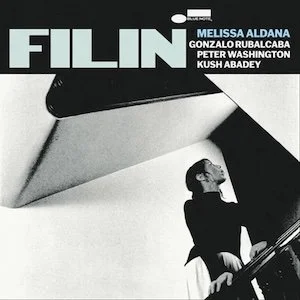
Chilean-born saxophonist and composer Melissa Aldana has long expressed the desire to record a ballads album in the tradition of John Coltrane and other masters. She fulfills that intention with her new quartet—Gonzalo Rubalcaba on piano, Peter Washington on bass, and Kush Abadey on drums—while adding a distinctive twist: the repertoire is devoted exclusively to Filin songs, a US-influenced Cuban style popular from the late 1940s to the early 1960s. Filin, her third release as a leader on Blue Note Records, contains moments of genuine romanticism, though it does not consistently deliver the spark or sense of discovery that might make the material fully compelling.
The album opens with a confident reimagining of Salvador Levi’s “La Sentencia”, where the delicacy of touch in the rubato piano playing and the velvety saxophone establish an inviting mood. The melodies, shaped with a soulful warmth à-la Charles Lloyd, rest securely on Washington’s rounded, supportive bass lines and Abadey’s soft brushes-on-snare and cymbal legato. “No Te Empeñes Más” introduces guest vocalist Cécile McLorin Salvant, whose expressive delivery enhances the piece, alongside heartfelt solos from Aldana and Rubalcaba. Salvant also appears on “Las Rosas No Hablan”, written by Brazilian samba master Cartola, rendered in graceful Spanish and sustained by the quartet’s refined accompaniment.
Brazilian presence is further felt through “Little Church” by Hermeto Pascoal, one of the album’s highlights. The piece moves between soulful lyricism and spacious dimensions, with Aldana’s saxophone projecting an almost ethereal glow over Rubalcaba’s sensitive pianism and Abadey’s subtle rhythmic commentary. “Imágenes” and the closing “No Pidas Imposibles” unfold as languid meditations, the former marked by Aldana’s wistfully dark yet airy tone, the latter distinguished by Rubalcaba’s exquisite grace.
Aldana’s unique musical habitat—where passages coalesce with discretion and often in predictable contours—finds particular resonance in “Ocaso”, composed by Mexican guitarist Claudio Estrada. The main melody has a dark feel to it, while the final vamping pulse comes injected with a disengaged, almost unconcerned air.
Yet while the musicianship is consistently polished here, Aldana’s artistic voice tends to resonate more vividly to me when she channels her creativity into her own original compositions.

Favorite Tracks:
01 - La Sentencia ► 05 - Las Rosas No Hablan ► 06 - Little Church