
Nick Fraser - Areas

Label: Elastic Recordings, 2026

Personnel - Tony Malaby: tenor and soprano saxophone; Kris Davis: piano; Nick Fraser: drums, piano harp; John Kameel Farah: electronics and sound processing (#1,4,7).
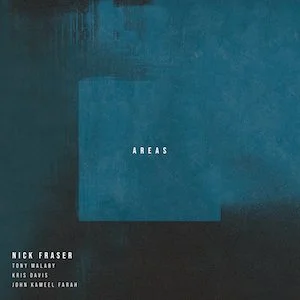
Toronto-based drummer and composer Nick Fraser reunites his exploratory trio for a third outing, Areas. There’s a remarkable synergy within this forward-looking, bass-less group, rounded out by two fearless musicians: pianist Kris Davis and saxophonist Tony Malaby. With Fraser’s unobtrusive yet ever-present rhythmic drive anchoring the foundation, Davis injects rich harmonic color and angular melodicism, while Malaby—a force to be reckoned with in contemporary jazz—consistently impresses with gruff, confident tenor attacks.

Three of the album’s six pieces are credited to Palestinian-Canadian pianist John Kameel Farah, who digitally processes duo improvisations by Fraser and Malaby. “In the Wreckage” opens the record in a dispersed, disorienting, and gloomy mode; “Howling Circuits” leans on drone-based processing, with Fraser on piano harp; and “Brood” sustains an eerie, incantatory languor within its sinister atmospherics.

Mimic” is a highlight, unfolding with simultaneous intensity, shadow, and complexity. Ominous low-register percussive attacks—emerging from a clever blend of standard and prepared piano—alongside shimmering cymbal textures, invite Malaby to expand into a high-powered middle-register vortex, unleashing guttural multiphonics and cyclic sweeps with growling force.

Equally striking is “There Are Other Ways”, which brims with excitement. Malaby’s solo introduction finds contrapuntal support in Davis’ quasi-mechanical motion. As the saxophonist delves into brooding sonorities, emphasizing an earthy tone and impressive range, Davis locks into a woozy, spiraling, almost robotic march, with Fraser’s active drumming providing propulsion. The trio transports us into an uncharted, rambunctious sonic universe where textures are fragmented and reassembled with daring intent.

Area” adopts a more ruminative stance. Initially, Malaby resists steering his expressive horn toward a fixed destination, while Fraser and Davis anchor an angular terrain with curiosity and tension. This unease soon erupts into a storm, marked by weighty, cacophonous saxophone interjections delivered with biting tone and piercing acuity. It ends calmly, though, melodically driven by soprano. Initially tense, the closer, “Sketch 57”, suggests a meditation, with gradually harmonized passages underpinned by rattling percussion and ample space for free interaction. The trio engages in a fluid sonic conversation whose sinuous paths lean into abstraction, with a brief but effective surge in intensity.

Fraser’s compositions foster a flowing improvisational language, allowing each musician to showcase distinctive timbres and dynamic interplay in service of the collective. Areas offers a compelling mix of surprise and atmosphere, striking a thoughtful balance between formlessness and structure.

Favorite Tracks:
02 - Mimic ► 03 - Area ► 05 - There Are Other Ways


Nick Fraser - Is Life Long?

Label/Year: Clean Feed, 2017

Lineup - Tony Malaby: tenor and soprano saxophone; Andrew Downing: cello; Rob Clutton: double bass; Nick Fraser: drums.

nick-fraser-Is-Life-Long.jpg

Canadian drummer/composer Nick Fraser, a stalwart in the Toronto jazz scene, targeted a sequence for his previous albums, Towns and Villages (Barnyard Records, 2013) and Starer (independently released, 2016), with a new Clean Feed outing, which features exactly the same chord-less chamber quartet with Tony Malaby on saxophones, Andrew Downing on cello, and Rob Clutton on double bass.

Is Life Long? comprises six intuitively connected tunes that, mirroring freedom, develop within mood-changing structural blocks.

Quicksand”, opening with long, contrasting-in-pitch, and quite ominous notes from arco and soprano, tinge a mysterious canvas with their eldritch presence. Thoroughly coordinated in these moves, Malaby and Downing devise the right wispy strains of melody to compose an unsettling atmosphere, having Fraser’s ruminative percussion as an underpinning. After dwelling in this vague suspension for one-third of the piece's duration, parallel movements of sax and cello commence, conveying a wider sense of cohesiveness but only to split up again for an organic polyphonic exploration. The tune shakes with turbulence in its final section, emphasizing Malaby's classy timbral work, acutely affixed to his peremptory exclamations, while flanked by the increasingly muscled thumping of the bandleader. At this point, one feels impelled into a tumultuous sonic epicenter.

A timing bass groove, obeying to an odd meter, sets the tone for “Disclosure”, an atypical yet majestic march where Fraser resorts to the hi-hat rather than the common snare rolls to set the pace. There are engaging chamber flourishes that suggest some relation with distant oriental places, creating in simultaneous a sensation of pure avant-garde ecstasy.

The fugue-like “Empathy” couldn’t have been given a better title since all the instrumentalists worked for a universal melodicism/organicism whose fluency encases dramatic classical movements delivered to the point.

Dissociating from the remaining tunes, the more-docile-than-acerbic “Skeleton” is a pleasurable swinger that shines from one end to the other via well-delineated jazzy unisons, a bouncy bass pizzicato, and constructive brushed drumming. Although nodding to tradition and advertising Mingus (mostly due to Malaby’s tenor rides), it feels utterly up-to-date in its unlocked musicality. 

The curtains close after “The Predictor”, a slow-cooked recipe that takes time to shape and evolve. After a bemused embryonic state, it morphs into peppery percussive cadences and heavy, provocative agitations.

Fraser’s stylized signature is well patented on Is Life Long?. Whether unobstructed or congested, the gripping ambiances sketched by his deft quartet surround us with an unfaded, exploratory impressionism.

       Grade A-

       Grade A-

Favorite Tracks: 
01 - Quicksand ► 02 - Disclosure ► 04 – Skeleton