
Otomo Yoshihide / Kei Matsumaro - Shutsumin

Label: Trost Records, 2026

Personnel - Otomo Yoshihide: guitar, turntable; Kei Matsumaro: alto and soprano saxophone, electronics.
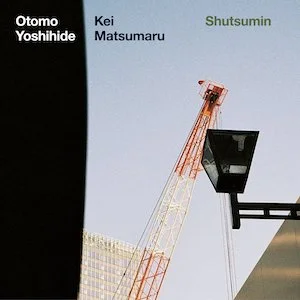
It was hard to connect with this experimental free-jazz duo release by Japanese guitarist Otomo Yoshihide and saxophonist Kei Matsumaro, a native of Palau New Guinea. The album, Shutsumin (a Japanese term referring to the transitional state between sleep and wakefulness, often accompanied by hallucinations and other abnormal sensations), traffics in otherworldly sounds and may well put anyone to sleep, starting with a cold blizzard of cosmic, radioactive pollution that arises from the electronic manipulation of guitar and turntable—emanating torrents of feedback and distorted granularity—alongside piercing, strident saxophone spirals that can be a strain on the ears.

Scattered rattling noises and directionless saxophone whirls convey the sensation of standing amid dozens of rusty industrial machines at work. Expect buzzing nuisances, intensifying guitar noise, and heavy, blurring distorted fluxes in a sort of machine language that overwhelms more than it enchants. These fearless explorers take us to uncertain soundworlds charged with labyrinthine, cluttered passages, coordinated overtones, firework-like bursts, and anxious apprehensions.

The last three tracks on the album had a more positive effect on me, showcasing a few compelling atmospheres while taking a more substantial and less repetitive, if still abstract, line of action. Folksy melodies begin to surface from Matsumaro’s saxophone over blaring mosaics in the background; cyclic cadences evolve from ambient textures into chaotic clamor before receding into confused murmurs. Things become more interesting and gripping with a stronger harmonic context—thanks to Yoshihide’s hypnotic chords—rather than relying on plain, unceasing buzzing noise.

I’m a big fan of Yoshihide’s quintet albums ONJQ Live (2002) and Tails Out (2003), some of his work for Tzadik Records—Flutter (2001) and Dreams (2002)— as well as his inventive, fantastic take on Eric Dolphy’s Out to Lunch (2005). Matsumaro is a new discovery for me. As a duo, they show considerable promise and are unafraid to push the envelope, but ultimately deliver less than expected. Despite its unevenness, Shtsumin may be considered by curious audiophiles with an inclination for sound manipulation.

Favorite Tracks:
06 - Utatane ► 07 - Oneiric ► 08 - Meisekimu


Matthew Shipp Trio - New Concepts in Piano Trio Jazz

Label: ESP-Disk, 2024

Personnel - Matthew Shipp: piano; Michael Bisio: bass; Newman Taylor Baker: drums.

The trio of American pianist Matthew Shipp, featuring bassist Michael Bisio and drummer Newman Taylor Baker, has been deservedly praised for their complex rhythmic calculus and hypnotic reveries. Their intriguing frameworks, rich in abstract compositional constructs and impromptu discourse, cohere in each album, and that’s no exception for their new endeavor, New Concepts in Piano Trio Jazz.

Primal Poem”, delicate and focused with a perceptible riff at the core and a three time feel, starts the album, followed by “Sea Song”, a tonally noir exercise with sizzling brushwork, recurrent bass pedals, and well-cadenced piano textures.

Other reflective tracks include “Tone IQ”, “Brain System”, and “Brain Work”, but the winners are “The Function” and “Non Circle”. The former, straddling the line between familiar and new, features walking bass lines supporting Shipp’s expressionism, which manifests as ricocheting rhythmic motions, fully-formed figures, and splendid note constellations. “Non Circle”, initially defined by Baker’s solid groove, denotes a disjointed nature, eventually taking heavy steps with polyrhythmic adornments. The motion here impresses, while the intense piano spurts often surprise. “Coherent System” completes the album with another telepathic, charismatically progressive performance underpinned by Baker’s martial snare fluxes. 

Not as brilliant as Piano Song (2017) or The Unidentifiable (2020), these new concepts still exemplify Shipp Trio’s musical capacity and inventiveness.

Favorite Tracks:
03 - The Function ► 04 - Non Circle ► 08 - Coherent System


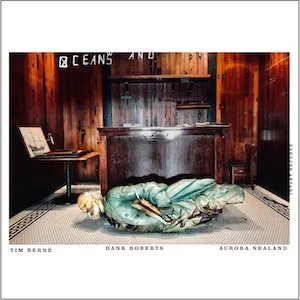
Tim Berne / Hank Roberts / Aurora Nealand - Oceans And

Label: Intakt Records, 2023

Personnel - Tim Berne: alto saxophone; Aurora Nealand: accordion, clarinet, voice; Hank Roberts: cello.

Tim Berne, an alto saxophonist with unpredictable musical temperament and a more-precise-than-brittle tone, teams up with master cellist Hank Roberts (a longtime partner), and multi-reedist/accordionist/vocalist Aurora Nealand (second musical experience after having joined forces with the duo Trapper Keaper in 2019). These musicians, owners of an excellent instrumental sound and big ears, put a spin on a unique post-modern trio that intrigues and captivates at every turn.

Their melding of ideas, eschewing genre conventions, is encapsulated in the 12 tracks that compose Oceans And. Take the opener as an example: “The Latter”, whose elongated, sustained notes with occasional screeching cello convey a mysterious tranquility, has Nealand’s atmospheric accordion giving harmonic context to Berne’s lines. And yet, one never knows where this gentle dance will take us.

Framed” is fed by accordion’s elliptical textures, grievous cello, and saxophone motifs that, spreading across the tapestry, show no interest in eradicating tension. The next track, “Eez”, takes abstraction, fragmentation, and looseness even further with its constant diffusion of timbres.

Partial 2” is an incredible piece that can be tied to “Clustard” and “Sutile”. The clarinet (surprisingly not as dulcet as one might expect) and saxophone engage in logical articulations that probe different intensities, while Roberts remains imperturbable in the back. The cellist excels during the eerie neo-folk of “Frosted”, emphasizing dark-hued elements with a firm identity.

Nealand puts her beautiful voice at the service of “Mortal and Pestered”, a haunting, ritualistic and often dramatic combination of the ethereal and the spectral, whereas on “10tious”, the longest piece on the album, she responsively attempts to mimic Berne’s intricate leaps and rhythmic trajectories on the accordion. There’s also cello pizzicato and quick-witted saxophone, with the protagonists coming and going from the scene with a particular aesthetic in mind.

This trio of like-minded artists offers strangely magnetic music with enough coils and refinements to keep you engaged.

Favorite Tracks:
02 - Framed ► 06 - Mortal and Pestered ► 11 - Partial 2