
Nick Fraser - Areas

Label: Elastic Recordings, 2026

Personnel - Tony Malaby: tenor and soprano saxophone; Kris Davis: piano; Nick Fraser: drums, piano harp; John Kameel Farah: electronics and sound processing (#1,4,7).
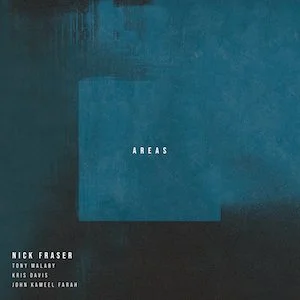
Toronto-based drummer and composer Nick Fraser reunites his exploratory trio for a third outing, Areas. There’s a remarkable synergy within this forward-looking, bass-less group, rounded out by two fearless musicians: pianist Kris Davis and saxophonist Tony Malaby. With Fraser’s unobtrusive yet ever-present rhythmic drive anchoring the foundation, Davis injects rich harmonic color and angular melodicism, while Malaby—a force to be reckoned with in contemporary jazz—consistently impresses with gruff, confident tenor attacks.

Three of the album’s six pieces are credited to Palestinian-Canadian pianist John Kameel Farah, who digitally processes duo improvisations by Fraser and Malaby. “In the Wreckage” opens the record in a dispersed, disorienting, and gloomy mode; “Howling Circuits” leans on drone-based processing, with Fraser on piano harp; and “Brood” sustains an eerie, incantatory languor within its sinister atmospherics.

Mimic” is a highlight, unfolding with simultaneous intensity, shadow, and complexity. Ominous low-register percussive attacks—emerging from a clever blend of standard and prepared piano—alongside shimmering cymbal textures, invite Malaby to expand into a high-powered middle-register vortex, unleashing guttural multiphonics and cyclic sweeps with growling force.

Equally striking is “There Are Other Ways”, which brims with excitement. Malaby’s solo introduction finds contrapuntal support in Davis’ quasi-mechanical motion. As the saxophonist delves into brooding sonorities, emphasizing an earthy tone and impressive range, Davis locks into a woozy, spiraling, almost robotic march, with Fraser’s active drumming providing propulsion. The trio transports us into an uncharted, rambunctious sonic universe where textures are fragmented and reassembled with daring intent.

Area” adopts a more ruminative stance. Initially, Malaby resists steering his expressive horn toward a fixed destination, while Fraser and Davis anchor an angular terrain with curiosity and tension. This unease soon erupts into a storm, marked by weighty, cacophonous saxophone interjections delivered with biting tone and piercing acuity. It ends calmly, though, melodically driven by soprano. Initially tense, the closer, “Sketch 57”, suggests a meditation, with gradually harmonized passages underpinned by rattling percussion and ample space for free interaction. The trio engages in a fluid sonic conversation whose sinuous paths lean into abstraction, with a brief but effective surge in intensity.

Fraser’s compositions foster a flowing improvisational language, allowing each musician to showcase distinctive timbres and dynamic interplay in service of the collective. Areas offers a compelling mix of surprise and atmosphere, striking a thoughtful balance between formlessness and structure.

Favorite Tracks:
02 - Mimic ► 03 - Area ► 05 - There Are Other Ways


Shawn Lovato - Biotic

Label: Endectomorph Music, 2026

Personnel - Ingrid Laubrock: tenor saxophone; Shawn Lovato: bass; Henry Mermer: drums.

Shawn Lovato is a New York-based bassist and composer with a daunting artistic perspective. Biotic marks an impressive trio debut alongside two other modern sculptors of sound, saxophonist Ingrid Laubrock and drummer Henry Mermer.

Showcasing open-mindedness and an extraordinary capacity for communication, the trio kicks off with “Spling”, which seems to draw on the patterned dynamics of electronic music. With the rhythm section cleverly anchoring the piece through syncopation-infused motion, Laubrock delivers a slyly virtuosic discourse packed with invigorating impromptu tangents. “Frequent Flyer” serves as a rousing nod to punk music—one of Lovato’s early influences—moving with elastic vigor while bringing to mind the Chris Speed Trio. Lovato embarks on a supple bass solo without ever losing sight of the tune’s lively harmonic progression.

Both “One Step From Anything Easy” and the closer “Parachute Bloom” are saxophone–arco bass duets that explore contrasting dynamics with refinement and taste. While the former is freely improvised, the latter relies on stately unison lines.

The trio also displays precise, athletic unisons on “Patience and Hydration”, a piece imbued with a grounded sense of direction. Laubrock, Lovato, and Mermer read each other seamlessly, exchanging and consolidating ideas with vision and spontaneity. “Dirt Doesn’t Burn”—its title drawn from a magazine article—is set in motion by a compelling bass introduction, later injecting angularity and mesmerizing rhythmic accents. The group maintains an energized focus throughout, but it is Mermer who disperses his kit’s sounds like octopus tentacles in a striking, thematic drum dissertation.

At times rigorous, at others freely drifting, Lovato’s trio fuses the concrete and the abstract into a coherent postmodern aesthetic, revealing a deep collective connection and a shared affinity for exploration.

Favorite Tracks:
01 - Spling ► 04 - Patience and Hydration ► 06 - Dirt Doesn’t Burn


Caleb Wheeler Curtis - The True Story of Bears and the Invention of the Battery

Label: Imani Records, 2024

Personnel - Caleb Wheeler Curtis: stritch, trumpet, sopranino saxophone, tenor saxophone; Sean Conly: bass; Michael Sarin: drums, Eric Revis: bass; Justin Faulkner: drums.

Following the authoritative statement of Heat Map (Imani Records, 2022), saxophonist and composer Caleb Wheeler Curtis returns with The True Story of Bears and the Invention of the Battery, a double album featuring two finely tuned trios that excel in free-flowing interplay and fluid structures. Curtis, who now has four albums under his belt, plays three different saxophones and trumpet here, employing overdubs to create moments of contrapuntal and synergistic stimulation.

Disc One features Curtis alongside bassist Sean Conly and drummer Michael Sarin, who provide alert support across nine originals and a solo saxophone rendition of Arthur Blythe’s “Odessa”, where Curtis’ lyrical grace in on full display. “The First Question” is set in motion by leisurely groovy bass lines and understated drumming, before saxophone and muted trumpet appear in parallel. The horns explore an unaccompanied, ruminative passage before Conly’s bass returns with rhythmic flexibility, adding a dynamic lift to the piece.

This Cult Does Not Help” introduces a start-and-stop beneath a Monk-esque, propelling the trio into freebop territory as Conly’s swinging bass locks in with Sarin’s snappy brushwork. Curtis’ exploration of timbre conjures fluid melodic streams on both saxophone and trumpet. Offering a distinct mood, “A Feather is Not a Bird” gently dances through a simple three-note figure that repeats with hypnotic, contrapuntal intensity. 

The standout track, “Bears and the Invention of the Battery”, initially floats with soaring arco bass, effervescent drumming, and edgy reed and brass sounds. This later transitions into an electro-rock-inpired framework that, grooving and throbbing with spirited rhythmic displacements, features interesting improvisational ideas coming from Curtis. He maintains this zealous sense of direction on “Stellar Ray, See?”, building on top of methodic trap drums and inquisitive bass expressions. Sarin’s drum choices work like a charm and Conly’s resonant bass lines are enhanced by extremely tasteful patterns.

For Disc Two, Curtis enlists bassist Eric Revis and drummer Justin Faulkner for a set of ten Thelonious Monk compositions. Standout moments include the high-energy rendition of “Raise Four”, the gentle melodic clarity of “Reflections”, the infectious groove of “Oska T.”, and the blistering sax-over-drums manifesto of “Ugly Beauty”. Curtis also shines on “Jackie-ing”, balancing timbre, articulation, and inventive motifs with finesse.

Across both discs, Curtis sounds very much like himself, blending sensitivity and physicality. Each trio finds creative ways to explore their sound, making this album a distinct and valuable addition to Curtis’s discography.

Favorite Tracks - Disc One:
02 - The First Question ► 03 - This Cult Does Not Help ► 06 - Bears and the Invention of the Battery


Alex LoRe - Motivity

Label: Weirdear Records, 2024

Personnel - Alex LoRe: alto and C melody saxophone; Thomas Morgan: bass; Johnathan Blake: drums.

Saxophonist and composer Alex LoRe delivers a cool-toned tradition-leaning album with Motivity, where he showcases a musically inclusive spirit, paying tribute to one of his mentors, the late saxophonist Lee Konitz. Assisted by the powerful rhythm section of bassist Thomas Morgan and drummer Johnathan Blake, LoRe navigates his originals, one composition by Konitz, and three standards with grace and spontaneous ease.

The album kicks off with Schertzinger/Mercer’s “I Remember You”, executed with an openhearted, Konitz-like subjectivity, effortless swinging feel, and engaging improvisational exchanges. The influence of Konitz is unmistakable on the inquisitive “Like-Lee”, where fluid motion allows space for classical lyricism to emerge within the jazz lines. The piece is propelled by skittering drums and vamping bass processions. Konitz’s own “Thingin’” is a richly harmonic post-bop piece that, following a dedicated saxophone intro, offers an upfront bass solo as well as spirited bar trades with the drummer.

A Weaver of Dreams” radiates eloquent melodicism in its fairly straight-ahead setting, making for a fine companion to “’Tis Autumn”, which ascends with a heavenly melody, softly propelled by brushed drums. While these artfully executed standards sound familiar, the more striking moments come from the originals, particularly “Free” and “Overly Sentimental”. The former is a lush, spaced-out spontaneous piece that invites listeners to explore its curious, enigmatic tones. The latter, a contrafact on “I’m Getting Sentimental Over You”, swings infectiously, with LoRe overdubbing himself on C melody to create bop-ish polyphonic surprise.

LoRe brings a mature and thoughtful musical perspective to Motivity, and his tribute to Konitz feels genuine and well-crafted. However, one might wish for more original material. This impression should not be a problem for fans of Konitz, who may enjoy the stylistic nods paired with LoRe’s personal new views. 

Favorite Tracks:
06 - ’Tis Autumn ► 07 - Free ► 08 - Overly Sentimental

Darius Jones - Legend of e'Boi

Label: AUM Fidelity, 2024

Personnel - Darius Jones: alto saxophone; Chris Lightcap: bass; Gerald Cleaver: drums.

Darius Jones, a visionary saxophonist and composer with a sharp, angular approach and pungent tone, ranks among the best in contemporary improvised music. His latest trio album, Legend of e’Boi (The Hypervigilant Eye), marks the seventh chapter in his comprehensive Man’ish Boy series, which began in 2009 and will eventually encompass nine parts. This album delves into themes of Black mental health and healing of personal and collective trauma through therapy, community, and creative expression. Jones is accompanied by bassist Chris Lightcap and drummer Gerald Cleaver—both masters of groove and technique—who help channel the volcanic energy and tempered explorations Jones uses to convey his message.

The album opens with “Affirmation Needed”, where Jones delivers an emphatic, dynamically accented, and often motif-driven performance, erupting over a solid rhythmic foundation that provides grounding. Following a bass solo by Lightcap, delivered with impeccable articulation, Jones returns, probing the depths of his horn with incisive, expressive sounds. “Another Kind of Forever" begins with a joint effort by sax and bass, posing repeated musical questions, to which Cleaver’s drums respond with precision and creativity. The piece then picks up momentum, reminiscent of a train speeding along, before arriving at a ternary vamp, with a signature saxophone riff dancing above. The rhythmic idea persists, developing into a state of manic agitation.

No More My Lord”, the only non-original piece on the album, is a poignant recreation of a prison song recorded by Alan Lomax at Parchman Farm, Mississippi, in 1947. Jones' saxophone cries out with seismic intensity, pleading for freedom and healing, set against Lightcap’s slashing arco bass and Cleaver’s magnetic cymbal configurations. “We Outside” is loosened up with considerable ambiguity even when anchored by a steady 12-beat bass groove. In contrast, “We Inside Now” offers a more restrained, harmonious ballad where Jones blows his horn with a controlled, comfortable assurance.

The album concludes with “Motherfuckin Roosevelt”, a track where shifting tempos and moods provide a sense of elasticity. At the outset, we can feel a rock n’roll spirit, something raw and primitive that expands in its will to take us to different and better places. The musicians throw themselves into the music with an unrelenting passion. Their fascinating playing is intriguing, raw, and lush. Legend of e’Boi is a keeper.

Favorite Track:
01 - Affirmation Needed ► 02 - Another Kind of Forever ► 03 - No More My Lord


The Adam Larson Trio - With Love, From Chicago

Label: Outside in Music, 2022

Personnel - Adam Larson : tenor saxophone; Clark Sommers: bass; Dana Hall: drums.

Saxophonist Adam Larson leads a trio that reveals melodic sensibility and exploratory ken. His seventh album as a leader consists of a set of tunes well-worth exploring and dedicated to Chicago, a city with strong affinities to jazz and where he had the opportunity to grow as a musician. Joining forces with bassist Clark Sommers and drummer Dana Hall, this is the first outing of an intended trilogy featuring chordless trios. The threesome played together for the first time in 2014.

The album makes a vibrant start with the catchy African-influenced theme of “Angolan Babysitter”, an intense exhilaration composed by Larson and delivered with melodic purpose and energy. Curiously, the B section was inspired by the 2Pac's “I Ain’t Mad at Cha”, and there’s beautiful drumming here by Hall, who trades a number of bars with his cohorts before going solo. They really put a distinctive spin on this one, before proceeding to the more conformist “The Time You Forgot You Knew”, expressed with directness and controlled dynamics.

Like the previous cut, both “Kansas to Chicago” and “In Waiting” were penned by Sommers. The former, flowing with groove and swinging openness, brings the sly wit of Larson’s post-bop language to the fore, but also stresses the compatibility he has with this rhythm section. The latter tune is more peaceful in tone but no less interesting in terms of solos and spontaneous responses. 

Mixing elements of blues, rock and folk, Larson’s “Root Fruit” is pure sonic joy, making the magnetic acoustics another incentive to recommend the album. Three covers appear on the track list: “Wee See” by Thelonious Monk is an uptempo romp with syncopated motion followed by in the pocket swinging; “Twirl”, composed by saxophonist John Wojciechowski, is a buoyant 3/4 piece that nearly rocks while exhibiting rhythmic figures and abrupt changes of rhythm; and the romantic jazz standard “Portrait of Jennie” is delivered with a refined cool for a change of pace. Deserving wider recognition, Larson will certainly keep pursuing excellence in his following releases.

Favorite Tracks:
01 - Angolan Babysitter ► 03 - Kansas to Chicago ► 08 - Root Fruit